

Photo by David James Heiss
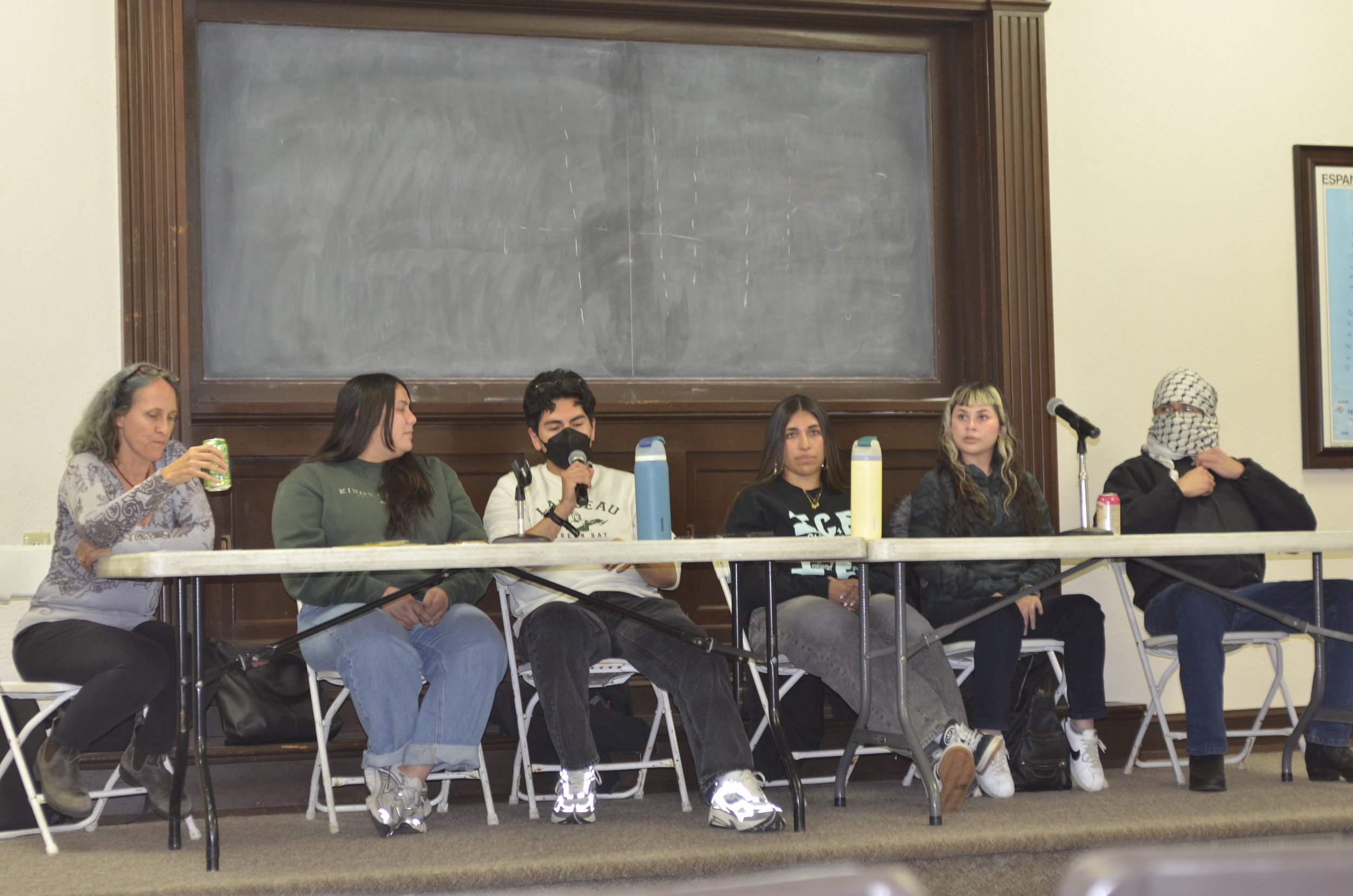
Panel participants, from left: UR professor Jennifer Tilton; IC4IJ organizer Esmeralda Santos; PEOC safety coordinator Angel Lira; Villa, a volunteer with Feed the Block and the Inland Empire Relief Fund; and another individual who did not divulge his identity, but appeared to be an activist with the ICE monitoring and response group Fontana Decolonized.
By David James Heiss
Redlands News Collective
REDLANDS, Calif. — The American economic system functions at the convenience of the business community by recruiting immigrants regardless of status but offering little support for their long-term residency, a University of Redlands professor said during a recent panel on immigrants’ rights.
Jennifer Tilton, chairwoman of the university’s race and ethnic studies department, spoke to nearly 30 guests at a Feb. 17 panel discussion held at the university’s Hall of Letters.
The program featured five activists and volunteers sharing their experiences with immigration issues.
Tilton noted that the local system dates to the 1890s, when Chinese laborers were phased out and business owners used threats of deportation to enforce compliance.
“We built an economy built on illegal immigration,” Tilton said. “Most Americans don’t realize that options for naturalization haven’t been built in.” She added that the federal government’s efforts to “dehumanize immigrants” have intensified under the Trump administration.
The panel included Esmeralda Santos, lead organizer with the Inland Coalition 4 Immigrant Justice; Angel Lira, health and safety coordinator with the Pomona Economic Opportunity Center; and Angel Coronado, an organizer with the Inland Empire Relief Fund and the Pomona Economic Opportunity Center. Two other participants remained anonymous: a volunteer using the pseudonym 'Villa' and a masked individual who declined to provide a name, citing the risks associated with their activism.
Panelists discussed tactics used by U.S. Immigration and Customs Enforcement (ICE) during raids and the conditions of detention facilities in the Inland Empire.
Santos said detentions have increased more than 1,000% and described conditions as “horrific.” She criticized the lack of medical care, stating that serious ailments ranging from broken bones to cancer are often treated only with over-the-counter pain relievers.
“ICE calling it ‘medicine,’” Santos said.
Villa said that ICE easily targets unhoused individuals who may not have access to IDs and personal paperwork, grouping those detainees as “others,” among the most marginalized. They pointed out escorts and advocates for immigrants are needed at courthouses.
Villa also said that there are “urgent needs” for all networks of volunteers and advocates to “create systems of care and safety networks to properly defend neighborhoods against this form of violence,” and a need for all the “little things, such as tending to a vehicle that is left behind when its owner is taken by ICE,” to delivering groceries to those who are too afraid or traumatized to leave their homes.
Althea Smock, a regional spokesperson for ICE responded to a request for comment after the event, clarifying remarks that were said by panelists.
“Any claim that there is overcrowding or subprime conditions at ICE detention facilities is FALSE,” Smock insisted. “All detainees are provided with proper meals, quality water, blankets, medical treatment, and have opportunities to communicate with their family members and lawyers. ICE has higher detention standards than most U.S. prisons that hold actual U.S. citizens. It is a longstanding practice to provide comprehensive medical care from the moment an alien enters ICE custody. This includes medical, dental, and mental health intake screening within 12 hours of arriving at each detention facility, a full health assessment within 14 days of entering ICE custody or arrival at a facility, and access to medical appointments and 24-hour emergency care. This is the best healthcare many aliens have received in their entire lives. Meals are certified by dieticians.”
Further, according to Smock, “Detainees are NOT being held in solitary confinement. While greatly expanding detention capacity thanks to the President's One Big Beautiful Bill, ICE has maintained its high-quality care including medical, mental, and dental care for illegal aliens. Ensuring the safety, security, and well-being of individuals in our custody is a top priority at ICE.
“Make no mistake, these types of lies are contributing to the over 1300% increase in assaults on the men and women of ICE who put their lives on the line every day to arrest violent criminal illegal aliens to protect and defend the lives of American citizens," Smock stated.
Coronado said many community members are now afraid to perform everyday tasks, such as grocery shopping or dropping children off at school. Because ICE tactics are unpredictable, she said the Inland Empire Relief Fund must constantly shift its strategy.
“It feels overwhelming,” Coronado said.
Santos highlighted an “urgent need” for legal services and funding for detention applications. She also noted that medical access is even more difficult for those who do not speak English or Spanish, citing a Mandarin-speaking woman who could not get a translation for paperwork regarding a tumor.
The event concluded with a call for volunteers. During the Q&A, attendee Jeff Wilson, a former university professor, asked how to make ICE officials more uncomfortable, suggesting protesters could make noise outside hotels or spit in their coffee.
Local resident Siw Heede responded by noting that online training is available for legal observers to monitor ICE activities safely.
To learn more, reach out to the Inland Coalition 4 Immigration Justice at info@ic4ij.org.
Additional information on how to offer assistance to nonprofits working on advocacy can be reached through ierelieffund@proton.me.
Due to the sensitive nature of immigrant advocacy, panelists in this piece have been granted anonymity to ensure their safety.