

U of R Students Bridge Faith and Activism to Challenge Local Book Bans
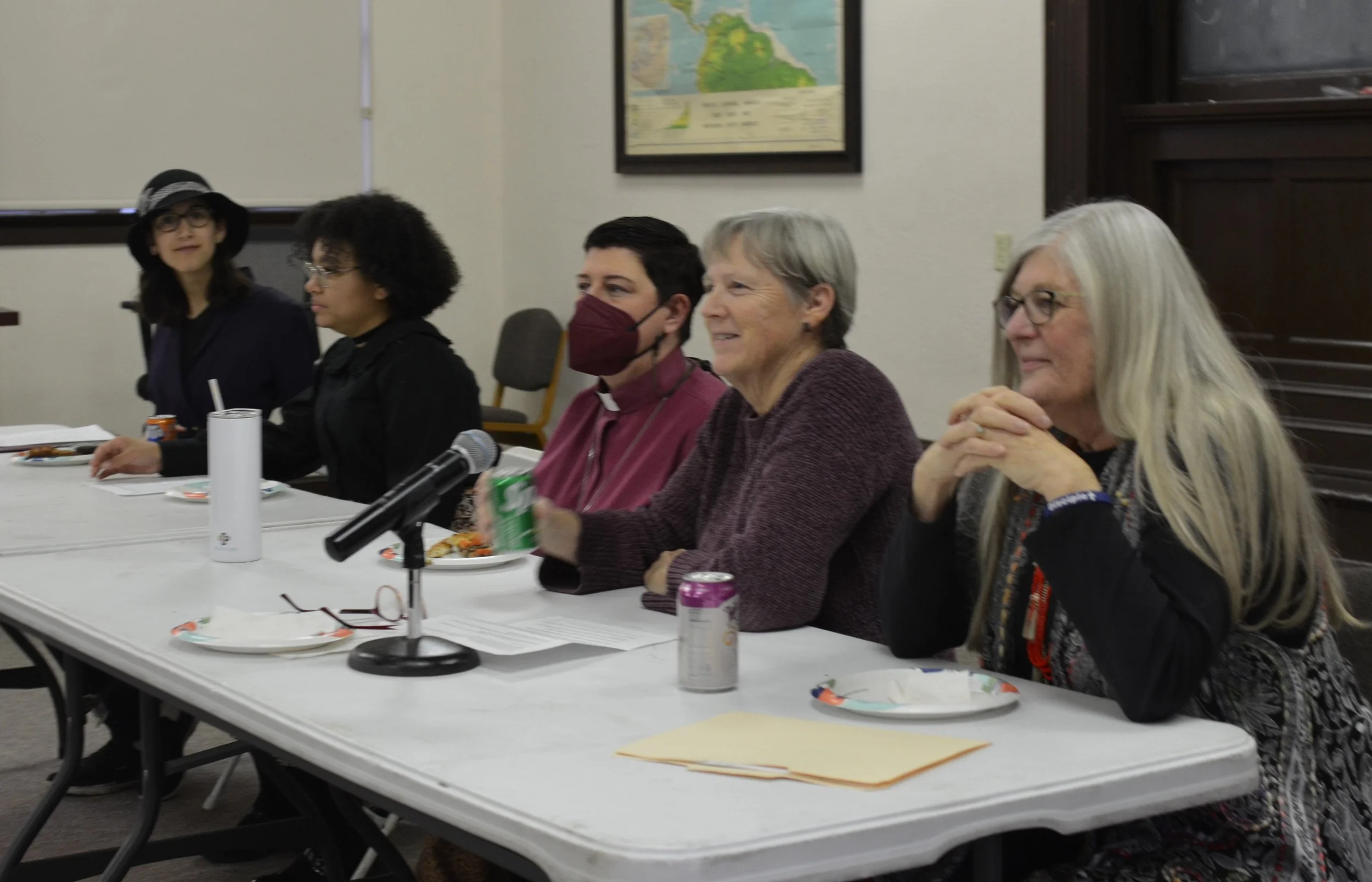
Photo by David James Heiss
Panelists participated in a discussion panel in the Hall of Letters at the University of Redlands. From left, Madeline Aliah, Aalistair Torres, Rev. Rachel Reeder, Rev. Cheryl Raine, and Rev. Shawn Zambrows.
By David James Heiss
Redlands News Collective
Driven by concerns that recent school board policies exclude students, two University of Redlands students organized an interfaith panel Monday to discuss the intersection of faith and social activism.
The Jan. 26 event at the Hall of Letters was coordinated by Madeline Aliah and Aalistair Torres, both students at the Johnston Center for Integrative Studies. Torres, who centers their studies on "Storytelling and Narratives for Social Change," and Aliah prompted the panel to address the climate of the local school district.
Panelists included the Rev. Rachel Reeder of First Lutheran Church; the Rev. Cheryl Raine of First Presbyterian Church; and the Rev. Shawn Zambrows of First Baptist Church. All three female pastors were among the local clergy who recently signed an interfaith letter urging school board members to prioritize inclusivity in their decision-making.
Zambrows noted that the district’s direction shifted sharply nearly a year ago.
“When the school board wanted to make significant changes regarding certain books in the library and flags celebrating identities of people, it felt like there’d been a takeover,” Zambrows said, drawing parallels to similar events in other districts.
The pastors specifically addressed the board's 3-2 decision to ban pride flags in classrooms and remove two books from libraries: “The Bluest Eye” by Toni Morrison and “Push” by Sapphire (Ramona Lofton).
Zambrows said members of her congregation hoped the church could express more support for marginalized residents, even though the church is not a political entity.
“I watched a board meeting online and was convinced there was more we could do,” she said.
Raine, who participated in local “No Kings” protest rallies, told the audience that her “faith had been hijacked.”
“I was motivated to participate because the board was making decisions to exclude people and make it unsafe for them to be who they are,” Raine said.
Reeder emphasized the importance of visibility, noting that LGBTQ+ members of her congregation needed to see that their church was a supportive, affirming presence in the face of board opposition.
Addressing the role of religion in politics, Raine argued that activism is a spiritual requirement.
“Jesus was not partisan,” Raine said. “He talked about getting engaged in the process, creating a society where all people were welcome, and justice was a big part of it.”
Raine criticized the board for ignoring its own established policies and the recommendations of its review panel when removing learning materials, accusing members of adhering to ideology over process.
Zambrows defined activism as a desire to make the world a better place through compassion and egalitarianism. She and the other panelists expressed frustration that opposing groups often use religion “as a cudgel” for coercion.
As the panel concluded, the pastors pivoted toward the upcoming election cycle as a means to “regain a semblance of normalcy.”
“It’s important for you to connect with what your passion may be,” Raine told the students. “What breaks your heart, what the world needs — get engaged and find people who will work with you.”