

LA Times Executive Editor Terry Tang Talks Trust, Truth, and Technology at Esri’s Redlands Forum
By David James Heiss
Redlands News Collective
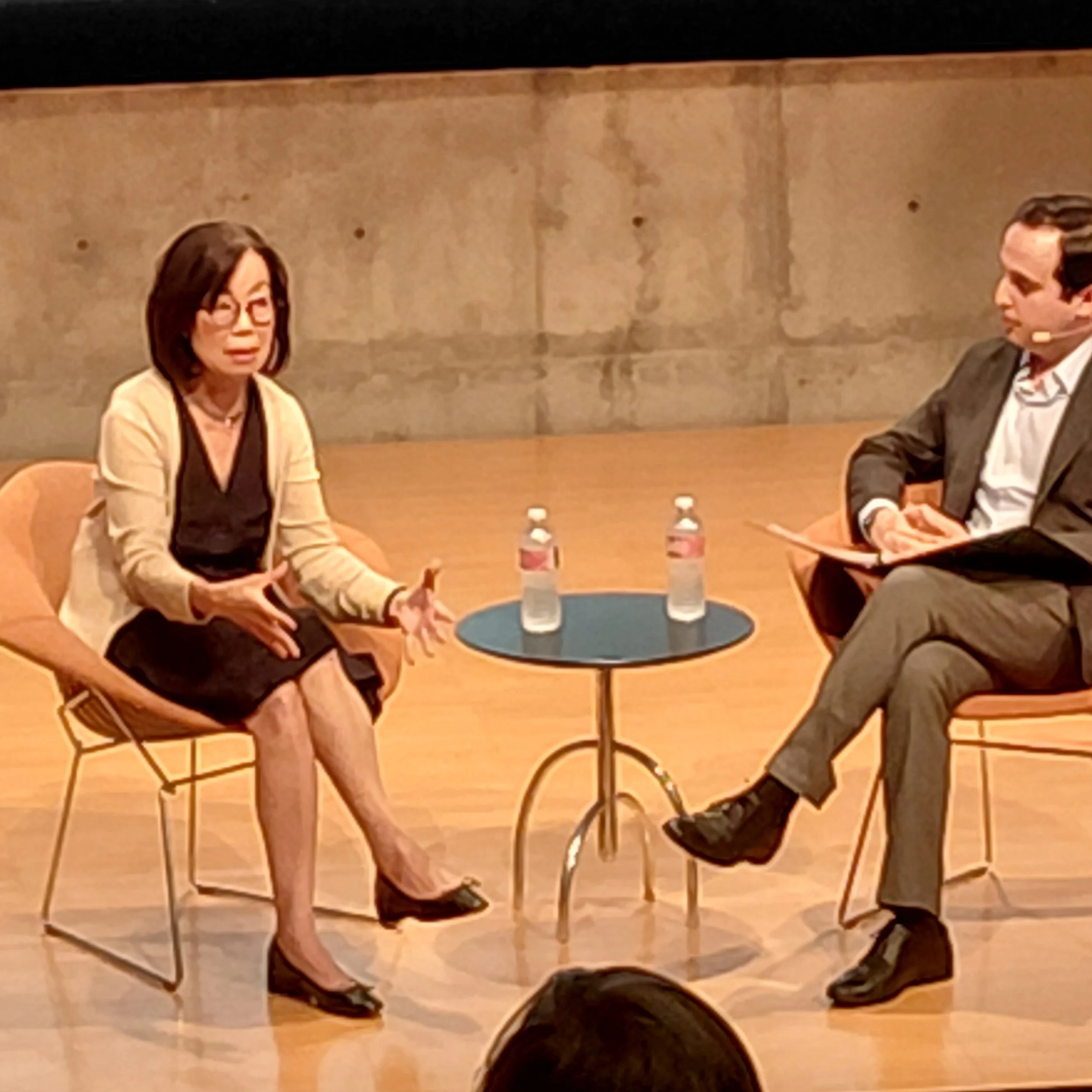
Photo by David James Heiss
LA Times editor Terry Tang, left, discusses journalism trends with Redlands Chamber of Commerce Director Evan Sanford.
REDLANDS — When Los Angeles Times editor Terry Tang recently surveyed journalism students at USC, she asked them where they go to look for their news.
It appears that TikTok, Instagram, Threads, and X tend to be where they turn to find out what’s going on in their world. “I asked: ‘Well, how many of you questioned the truth of what you’re reading?’ and almost all of them raised their hands,” Tang told guests who attended the Sept. 23 Redlands Forum sponsored by Esri. Tang had been invited to discuss “The Role of Journalism in Today’s Society.”
Appointed in 2024 as executive editor of the Los Angeles Times, she is the first female editor in the paper’s 142-year history.
Tang said that when she sees posts from various social media sites, she has to second-guess their veracity. “You can’t know” how credible the information is, Tang told students. “I had to say to them, if you are worried and you think that it’s not true,” she assured them, “what you know is that if you’re reading the LA Times — doesn’t have to be us, it could be the Washington Post — or any other major publication, you know that that is not going to be false, that we’ve made every effort to make it real. It isn’t social media where there are no guidelines. Nobody, even the influencer who is putting it up, may not know whether it’s true or false, even if there’s no evil intent, there’s no malice. They just don’t know.”
Professional journalists at longstanding, credible news institutions such as the Times or NPR adhere to a standard “by which we’ve made every effort” to go through several layers of fact-checking, ensuring there are multiple credible sources for stories.
She offered the consumption of “news” via social media as a comparison to determining where one should go to dine out. It was “almost like, I know this food may give me, you know, food poisoning, but I’m going to keep eating it. So, why don’t we go to a restaurant where there’s an A grade from the Department of Health?”
Redlands Chamber of Commerce President and CEO Evan Sanford, who has a background in broadcast journalism, moderated the program. He asked her to consider a “hypothetical” situation: “Let’s say there was a government who didn’t let certain outlets be able to cover what the government was doing? Would you have any thoughts on that — this is purely hypothetical,” considering recent discussions regarding press credentials.
Tang responded, “Well, this is also hypothetical,” adding that the First Amendment protects freedom of the press. “I don’t think the American people will let a government get away with that. Americans are independent-minded. If it’s the state government or the town council, the city leaders of Redlands saying, ‘You cannot write about us, you can never enter City Hall and ask anyone any questions because I suspect that you might say something I don’t like — whether true or not’ — I don’t think residents of this community would really accept that, or think that is the right thing.”
Sanford asked her, considering “the pressure to be timely, and with the responsibility of being right, and since digital publishing has placed newspaper journalists inside that continuous news cycle, has the demand to publish changed any editorial decisions that you and your newsroom make?”
“We know that speed is necessary,” Tang said. “One of the things that most newsrooms do now is that when there is news that we know is true, we will put up just a short, truncated version of that story, and we will say that this is a developing story. What used to happen in the luxury of the days when there was no internet and you just waited for your evening final edition deadline, you could work on that thing for, you know, six hours. What we do now is give the top line of the news and then continuously update that news so that you then see more and more of it. We don't want to sit on the news. We want to give it to readers right away.”
Sanford wanted to know whether artificial intelligence, or AI, was a contender for replacing existing journalism outlets and writers.
Tang said that AI can provide summaries of existing information, collect and analyze data, and scrape previously published materials from online sources, but does not currently have the ability to create original stories.
Sanford was curious as to what offers Tang hope for the future of journalism. “I have to say it is the young people,” Tang said. “You know, people who have been in journalism a while, you know, you’ve seen so much. A lot of it is difficult. You know, the shrinking of the footprint of news, news deserts arising where there were no news deserts. The change in the financial structure of news creation is enormous. If everybody in the newsroom at the LA Times were just 25-year-old fellows, as we have, everything would be rainbows and roses. They love being there. I'm sure their friends and their parents and relatives are wondering, ‘Why are you going into that profession?’ And they just think this is the best thing. They are so happy and grateful, and they're not thinking about what used to be. They just think, ‘I want to be a reporter, and want to go out there and unveil what other people are doing and expose wrongdoing; to hold government accountable.’”
The forums are free and open to the public via reservation. More information can be found at Esri’s website (esri.com/redlandsforum).
The next scheduled speaker will be on Oct. 7, featuring Adam Thunell, president and institutional CEO of Redlands Community Hospital, who will discuss healthcare policy, legislation, and local healthcare trends as part of a discussion titled “Healthcare at the Crossroads.”
Forums are held at Esri’s auditorium in Building Q, 380 New York St. in Redlands.