

Photo by David James Heiss
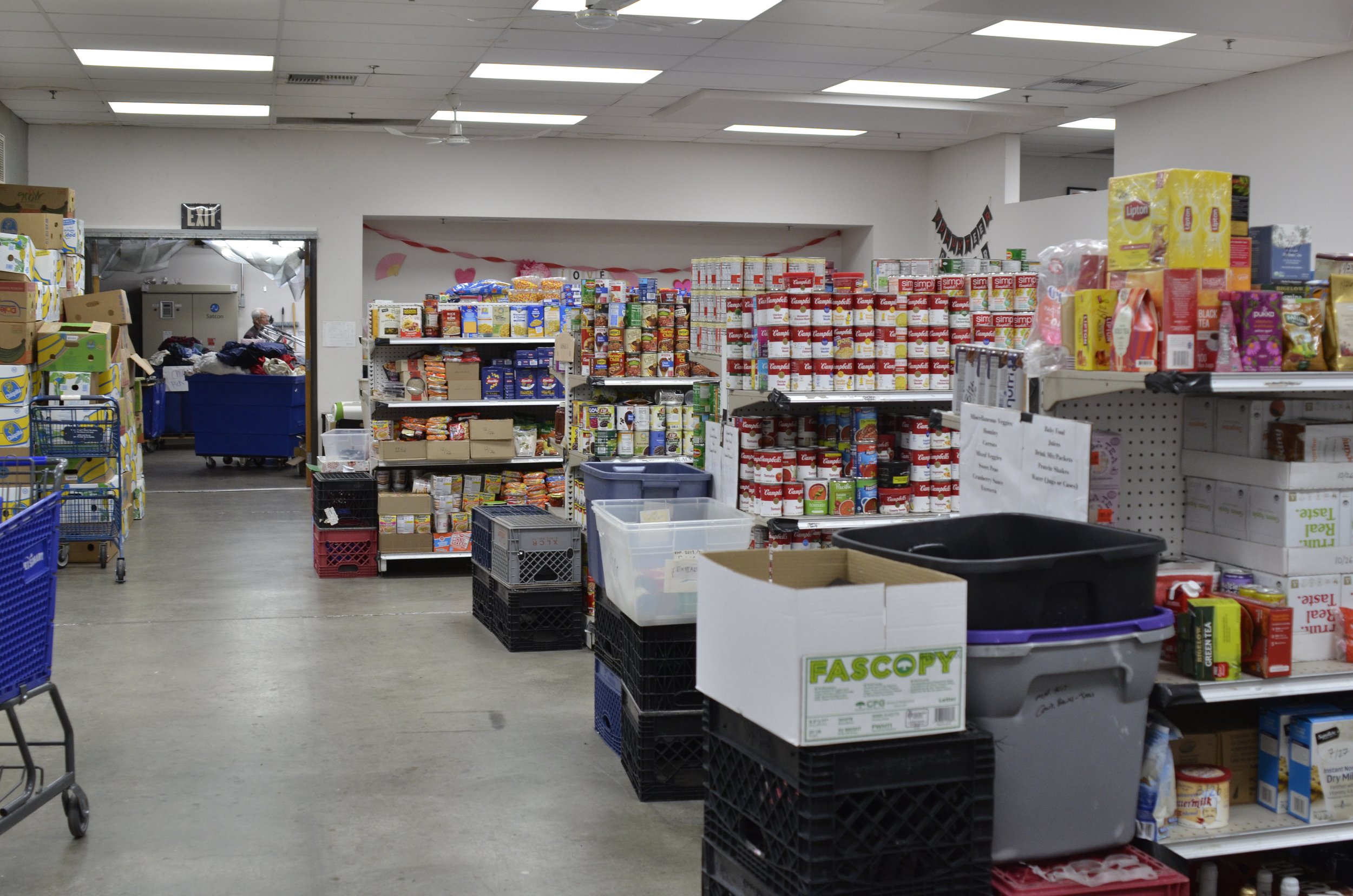
Food supplies at Family Service Association of Redlands.
By David James Heiss
Redlands News Collective
REDLANDS, Calif. — Homeless Solutions Coordinator David Rabindranath updated the City Council at its Feb. 3 meeting on the city’s food task force, an initiative established in November following federal cuts to the Supplemental Nutrition Assistance Program, or SNAP.
At a Jan. 8 meeting, city officials and representatives from the Family Service Association of Redlands, Salvation Army, Church of Religious Science, Stronger Together Now, The Blessing Center, the Redlands Charitable Resource Coalition, and the Riverside Ghanaian SDA Church met to analyze how the SNAP reductions impacted their programs.
Rabindranath said those organizations “saw triple to quadruple” the number of local families seeking food assistance.
The city’s nonprofit partners recommended increasing outreach and utilizing social media to better educate residents on available resources. Rabindranath noted that while the Redlands Unified School District provides student meals during the academic year, assistance becomes more difficult during summer break.
To bridge the gap, officials suggested making additional city facilities and nonprofit locations available as resource pickup sites.
Assistant City Manager Chris Boatman observed that the city could serve as a central repository for information and take the lead on promoting resource accessibility.
Councilwoman Denise Davis clarified that she intended for the initiative to be officially titled the Food Security and Child Nutrition Task Force. She noted that many families are on the threshold of losing grocery and utility assistance, a crisis compounded by rising healthcare and living costs.
“We need to meet more regularly,” Davis said, expressing surprise that many local partners had never participated in a collaborative effort of this kind. “No one in the city has brought together specifically a food security task force before, so I’m glad we’re having this conversation now.”
Davis shared statistics from Craig Turley, founder of The Blessing Center, that identifies 12,531 students as being low-income within the school district. Furthermore, 7,630 families — roughly 31% of the city’s population — are classified as low-income.
“Charitable giving is great and vital. I also think the city can and should be thinking about resources we can dedicate toward this effort as well,” Davis said.
Rabindranath assured Davis the task force would continue to meet every two months.
Councilman Paul Barich emphasized the need for a dedicated fiscal pipeline. Observing that no conduit currently exists for public contributions, Barich offered to help facilitate the creation of a framework to capture community support.
Boatman noted the city could develop an online mechanism to match contributors with specific organizations and resources.
Mayor Mario Saucedo acknowledged the multi-pronged effort of various organizations, but urged caution regarding the city's workload.
“We as organizations, as a city, are compassionate to try to provide the information through our website, through our programs,” Saucedo said, adding the caveat that the council should be “conscientious of adding another priority or another project to our staff” that is already managing limited funds.
During public comment, resident Bruce Laycook challenged the council’s priorities.
“Making sure the people of Redlands — particularly the children of Redlands — have food to eat: if it’s not one of your priorities, I’d like you to reconsider and make it one,” Laycook said. “It’s called redeploying resources you’ve got to care for the most vulnerable people in our community. It’s not an option. It’s your responsibility.”
The council voted unanimously to continue coordinating with nonprofit, faith-based, and school district partners to address food insecurity and to receive periodic updates.