

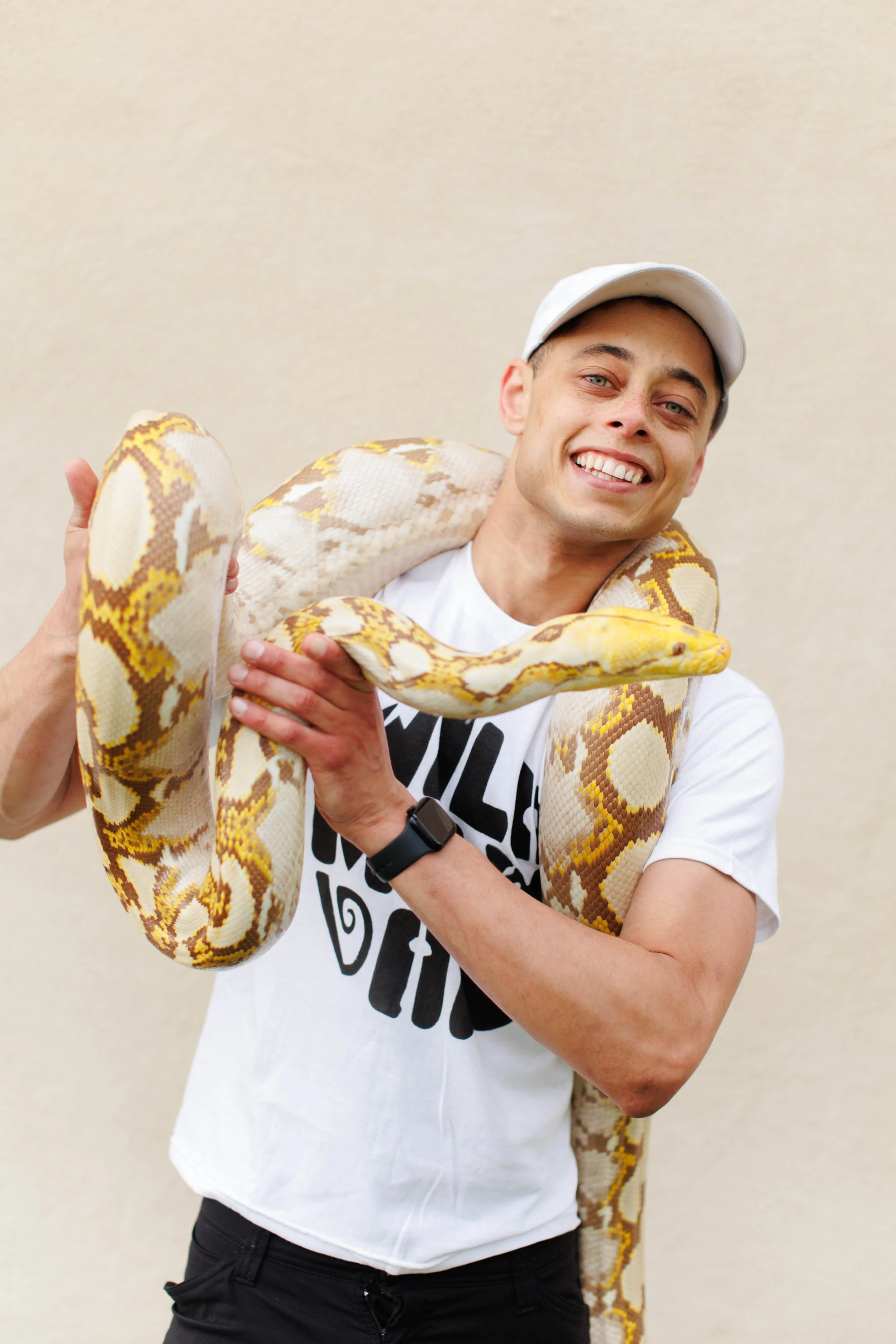
Courtesy photo
Daniel Quinones holds up Phantom, a reticulated python.
By Tiffany Rose Price
Redlands News Collective
REDLANDS, Calif. — Few animals provoke as much instinctive fear — and fascination — as snakes and spiders. For many, they represent danger, unpredictability and the unknown.
But for "Wild Man Dan," they are something else entirely: ambassadors of a misunderstood world.
Through live demonstrations and educational programs, Daniel Quinones has built a career on bringing people face-to-face with creatures they might otherwise avoid at all costs. His work sits at the intersection of entertainment and education, where curiosity replaces fear and hesitation gives way to respect.
In an era where viral misinformation and long-held myths still shape public perception of reptiles, Dan’s mission is both simple and ambitious: to change the way people see these animals, one encounter at a time.
I first met Dan after watching his educational performance for parents and students at a Redlands elementary school. He wasn’t only a herpetologist (a reptile expert), but his charisma was electrifying. I personally watched how he "snake charmed" the scaredy parents (that would be me) into being fully captivated. I even hired him for my son’s ninth birthday party!
I chatted to the reptile whisperer to satisfy my curiosity and to learn how to act should we come eye to eye with a rattlesnake.
RNC: What originally drew you to working with reptiles and arachnids?
Quinones: My mom says that from the age of 2, I was outside catching different creatures, and by the age of 3, I wasn’t allowed back into the house unless I emptied my pockets of whatever living animals I had stored in them. I think it was simply a God-given passion I was born with.
RNC: Was there a defining moment when you realized this could become a career?
Quinones: Yes. It was when I saw how people responded during live presentations. Someone who started out terrified of snakes could leave with respect and even appreciation. I realized this wasn’t just about animals — it was about education, reducing fear and creating meaningful experiences. That’s when I knew it could become more than a hobby.
RNC: What were some of the biggest challenges you faced early on?
Quinones: Building credibility was a major challenge. Many people assume working with reptiles is just entertainment, but there is serious science, safety, husbandry and education behind it. Financially, caring for animals properly is expensive. I also had to earn the trust of schools, libraries and organizations.
RNC: What is your ultimate career ambition?
Quinones: My ultimate goal is to create a Venom Discovery Center and Zoo in the Inland Empire. This facility would bring a zoo to an area that currently does not have one, while also housing some of the most incredible and unique venomous and poisonous species from around the world. I would love to continue collecting venom for research and medicine while educating people about the vast number of venomous and poisonous animals that exist.
On Snake Safety and Public Perception
RNC: What are the most important do’s and don’ts when encountering a snake in the wild?
Quinones: The biggest "do" is to give the snake space. Most snakes want to avoid people and will move on if left alone. Stay on trails, watch where you step and keep pets close. The biggest "don’t" is to never try to touch, kill or relocate it yourself. Most bites happen when people attempt to handle snakes.
RNC: What are some of the most common misconceptions people have about snakes?
Quinones: One misconception is that snakes are aggressive and chase people. In reality, they are defensive, not aggressive. Another myth is that baby rattlesnakes are more dangerous than adults, which is false. Adult rattlesnakes have the potential to inject more venom, and babies are very capable of controlling how much venom they use.
RNC: Here in Southern California, what snakes would we expect to encounter on a trail or in our yard?
Quinones: In Southern California, people may encounter gopher snakes, kingsnakes, coachwhips, garter snakes and seven rattlesnake species: the Southern Pacific rattlesnake, Red Diamond rattlesnake, Mojave rattlesnake, sidewinder rattlesnake, speckled rattlesnake, Western Diamondback rattlesnake and Northern Pacific rattlesnake. Gopher snakes are especially common and are often mistaken for rattlesnakes because they can mimic defensive behavior. Rattlesnakes are the only medically significant venomous snakes in the region.
RNC: How do you identify a venomous snake? What should we do if we are bitten by one?
Quinones: In Southern California, the only medically significant venomous snakes are rattlesnakes, so if you see a rattle or a nub on the tail, it is most likely a rattlesnake. Do not touch it. If bitten: Stay calm, limit movement, remove rings or tight items, keep the bite area at heart level and seek emergency medical care immediately. Do not cut the wound, suck out venom or apply a tourniquet. Remember: Time is tissue.
On Working With Animals
RNC: What goes into caring for and maintaining the health of your animals?
Quinones: A tremendous amount of work happens behind the scenes. Proper temperature gradients, humidity, nutrition, hydration, enclosure sanitation, enrichment and regular health monitoring are essential. Each species has unique needs, so care must be individualized. Animal welfare always comes before presentation schedules.
RNC: Do you own a snake or spider that is a protected species?
Quinones: I do not own any protected species, though I hope to obtain my scientific collecting permit so I can work with protected species for educational purposes.
RNC: How do you balance audience engagement with animal welfare?
Quinones: I keep several individuals of the same reptile species so they can rotate regularly. Each animal only works about one week out of the month, giving them ample time to rest and eat before returning to presentations. Public interaction is limited to 15 to 20 minutes maximum. The majority of my presentations involve me speaking and entertaining the audience, which helps reduce stress on the animals.
On Education and Entertainment
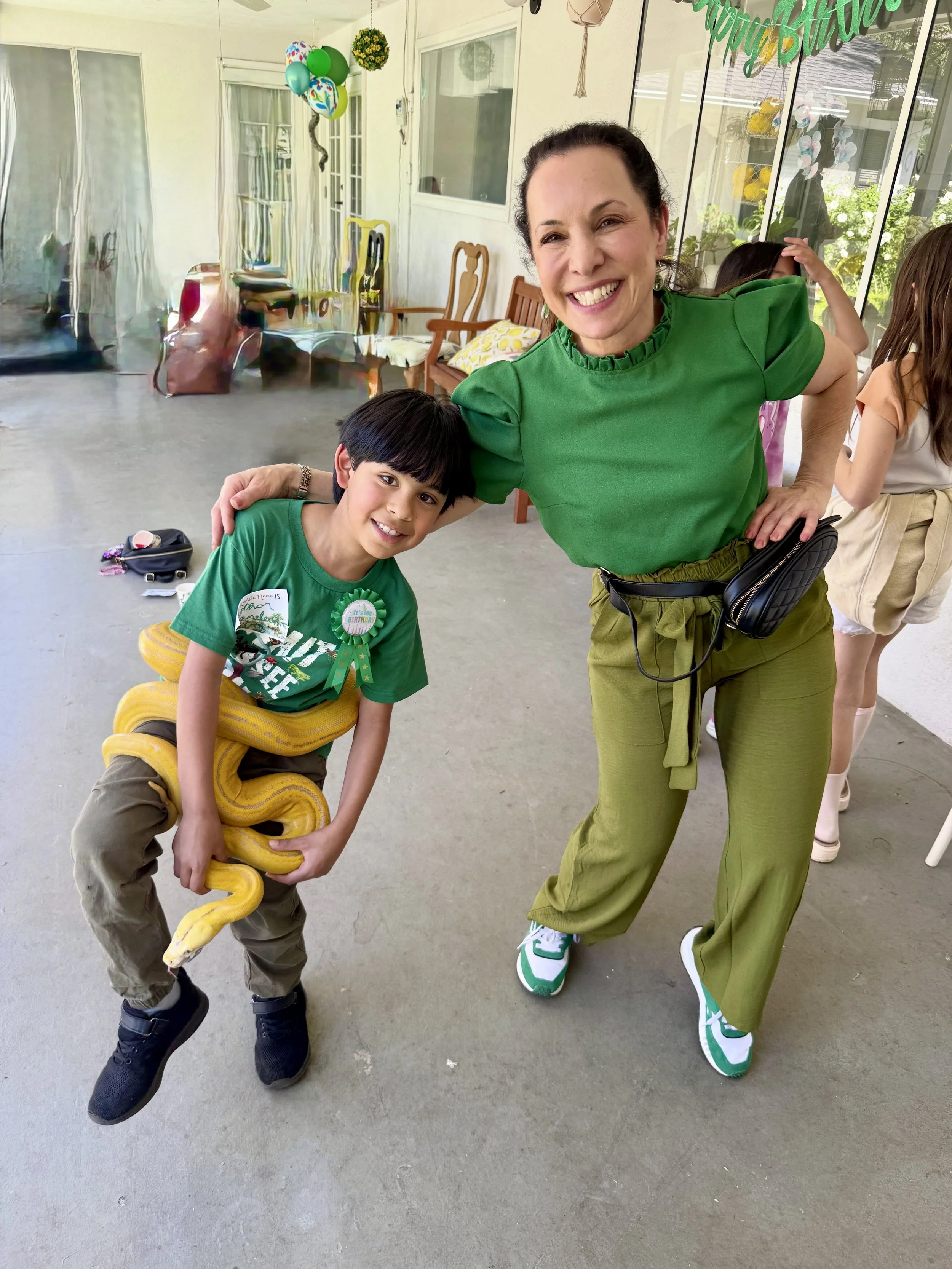
Writer Tiffany Rose with her son, Parker, at his ninth birthday party, which featured a visit by Wild Man Dan.
RNC: What role does entertainment play in helping people overcome fear?
Quinones: Entertainment lowers defenses. When people laugh, engage and become curious, fear starts to loosen its grip. Humor and excitement open the door, then education changes perception. It’s easier to learn when you’re relaxed, interested and having a good time.
RNC: How do you approach teaching adults differently from children?
Quinones: Aside from getting a little more technical and advanced with the information, I treat them much the same. I’ve found that adults are basically big kids — if you use humor and some back-and-forth interaction, most adults will laugh and engage with you.
RNC: Can you recall a moment when you saw someone’s perception completely change?
Quinones: Many times. I’ve had people begin a presentation standing in the back of the room because they were terrified of snakes, then by the end they were holding a snake and enjoying the experience. Watching fear disappear.
On Conservation and Impact
RNC: Why are reptiles and arachnids so important to ecosystems?
Quinones: They help control pest populations, serve as prey for other wildlife and maintain ecological balance. Snakes help reduce rodent numbers, while spiders consume massive quantities of insects. Remove them, and ecosystems become unstable.
RNC: What are the biggest threats facing these animals today?
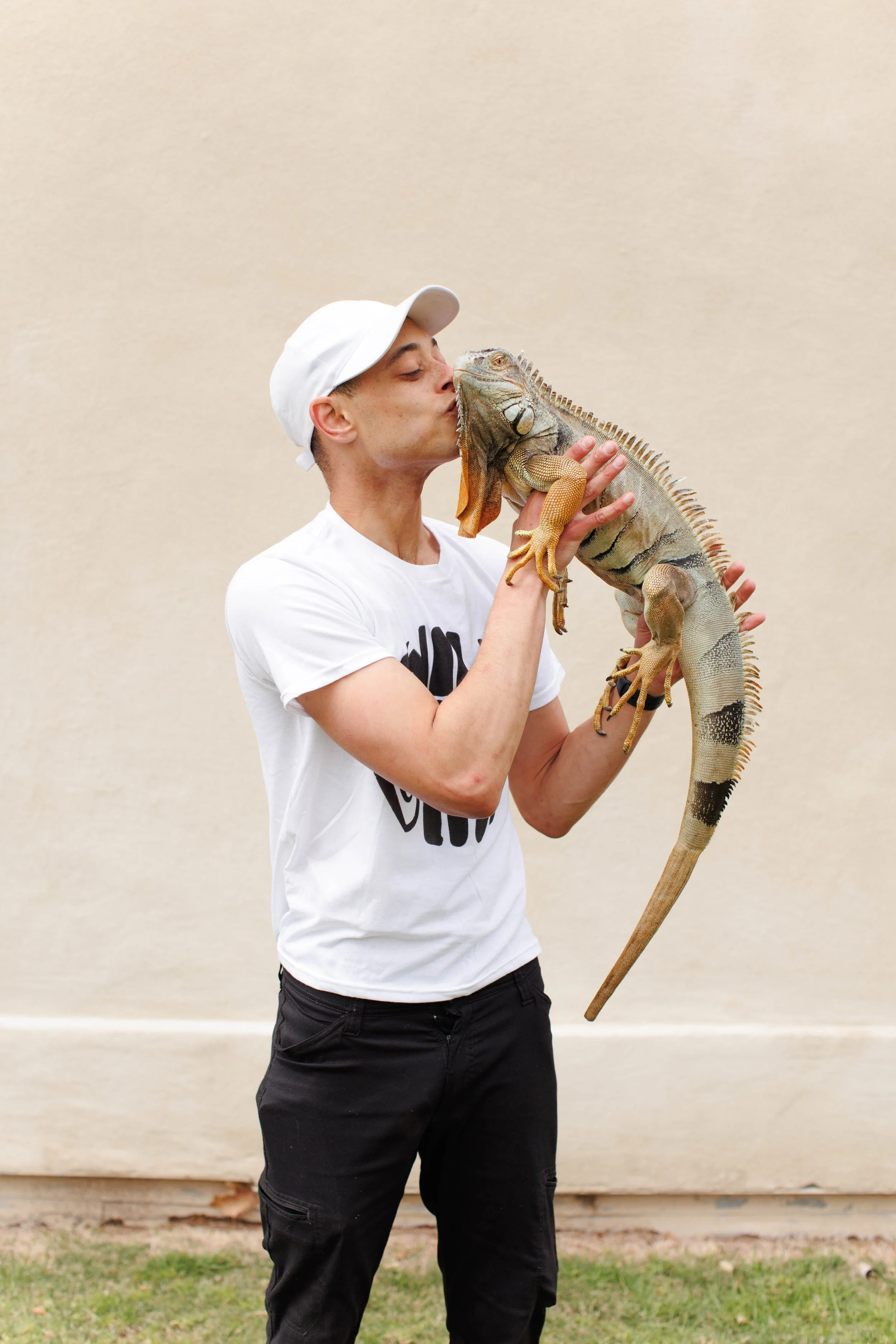
Wild Man Dan smooches Yuki, a green iguana.
Quinones: Habitat loss, road mortality, pollution and unnecessary killing driven by fear are major threats. Many animals die simply because people misunderstand them. Education is one of the best conservation tools we have.
RNC: What can individuals do to better coexist with them?
Quinones: Learn what species live in your area, keep yards free of rodent attractants and places where animals can hide, watch where you place your hands and feet outdoors, and contact professionals when needed. I would also like to begin teaching the public how to safely relocate rattlesnakes. Empowering people with that knowledge could drastically reduce fear and the number of bites each year.
Personal Perspective
RNC: What keeps you passionate about this work?
Quinones: Watching the smiles and laughter from people of all ages and helping them replace fear with respect. I also get to care for incredible animals and share their importance with others. When your work combines purpose, education and passion, it keeps you motivated.
RNC: How do you personally manage risk in such a hands-on field?
Quinones: Risk management is everything. Training, protocols, species knowledge, proper tools, reading animal behavior and never becoming overconfident are critical. Experience helps, but humility keeps you safe. I also have multiple safety measures in place to prevent anyone — including myself — from being bitten by venomous animals.
RNC: If you could change one thing about how people view snakes and spiders, what would it be?
Quinones: I would want people to stop seeing them as villains. They are not malicious creatures. They are simply animals trying to survive. Respect is far more appropriate than hatred.
RNC: After all your experience, what do you think people fundamentally misunderstand about fear—especially when it comes to animals?
Quinones: Fear often grows in the absence of knowledge. People think fear means something is evil or must be destroyed, when often it simply means something is unfamiliar. Once people understand an animal, fear usually becomes respect.
To book Wild Man Dan for an educational event or children’s party, visit www.wildmandanshow.com or call 505-730-6051.